Tuesday, June 30, 2009

Review: Glass Wall

Glass Wall opened in the Heights in 2006. That makes it the dean of the recent explosion of restaurants and other hot spots in the Heights and along the Washington corridor of Houston. From the beginning, Glass Wall has been trendy, and so it remains today. Big crowds come from the neighborhood, along with some of those wrap sunglasses-wearing, pinky ring-wearing, blueberry Stoli-drinking hipsters from the Washington scene who are looking for something “old school” like a three-year-old restaurant.

The best thing about Glass Wall hits you immediately upon walking in. It’s a relaxed atmosphere, inspired by chef Lance Fegen’s passion for surfing. A large (what else?) glass wall separates the bar from the main dining area. The room is colored in cool shades of blue, green, and white. The ceilings are high. And the worst thing about Glass Wall hits you at the same time: the noise. When will successful restaurants bother to invest a pittance in a few acoustic panels that would make it comfortable for a table of four or more speak in indoor voices?

In any case, Glass Wall doesn’t let its popularity and trendy reputation go to its head. The staff plays it cool, which is the best part of the restaurant’s personality. Everyone, from the put-together hostess and co-owner Ross Shepard at the front of the house to Chris the excellent bartender and the wait staff, keeps Fegen’s laid back, surfer mentality in mind.

From Glass Wall


The menu changes a couple times each quarter, keeping it in tune with the variety of seasonal produce. But the menu doesn’t have a heavy-handed seasonal overtone, which is emphasized by occasional inconsistency from the kitchen. There tend to be staple dishes offered, with a seasonal bent to them. Appetizers will include a play on a fried junk food; entrees choices will feature pork tenderloin, short ribs, grass-fed steak, and a white fish.

Fegen has a nice flair for the creative, jiving subtly with the surf theme of the restaurant. He’ll toss in a dash of exotic fruit unexpectedly or do something a little wild, like crust tenderloin in jalapeno potato chips. There is a kind of casual fearlessness about the food that jives with the surfer mentality.

At its best, Fegen’s dishes are some of the most imaginative and skillfully executed comfort food around. His oyster beignets on top of a candied bacon pancake with hollandaise and hot sauce syrup from the winter was one of the most inspired dishes in town. Fegen isn’t afraid to take risks with flavor combinations, as the current menu’s chorizo mashed potatoes demonstrate with glorious success. The chicken fried steak — in whatever form it takes on the menu — contends in “best of” discussions. He also makes good use of lesser known cuts like the flat iron, creating solid, tasty dishes that are reliable standbys.

Not every move by the kitchen is a hit, though. The pork tenderloin tends to be overcooked and boring. The recent preparation of short ribs has been dry, a bad misstep for meat that is difficult to overcook; it allows them to be overshadowed by the excellent gouda grits that share the plate.

From Glass Wall


Where Glass Wall tends to be weakest is when it makes efforts to go more upscale. The best example is the bread service. Having someone come over with a selection of bread feels out of place, and the constantly awkward demeanor of the server underscores that. The poultry dishes are more pedestrian, coming off as an exercise in the mundane and seemingly prepared out of obligation to expectant diners.

The wine list is fairly limited but, in comparison with its peers, smartly chosen. The prices are decent; you can usually find something worth drinking. Kudos to them for suggesting a wine pairing with each dish on the menu, even appetizers. These tend to be the most interesting wines they serve. Glass prices are the now-standard $9 to $14 range.

The noise level can be blistering, which makes sitting in the bar an attractive option. It is quieter there, and it’s also a great place to watch sports. Given this, Glass Wall really succeeds in being a better version of Max’s Wine Dive: smart comfort food done in a laid back atmosphere, rather than the arrogantly in-your-face flavors you find at Max’s that are too obvious to merit serious interest. Glass Wall has a terrific ability to cut down your craving for greasy comfort food in the way a great diner does, and it will make you feel slightly cool at the same time. A bit sharper focus and consistent execution on the more complex, ambitious dishes, and it would rise up another notch.

Tuesday, June 23, 2009

Amuse bouche: What's with the savory desserts?

Everywhere you look at fine dining restaurants nowadays, it seems you run into desserts that flirt with the line between sweet and savory. The extremely talented Plinio Sandalio of Textile may be the current Houston leader in this regard, with some interesting results. But it's a fad that needs to end. They've been doing it at Alinea since the place opened and on Iron Chef for years before that. The sweet-savory exploration has taken longer to throw roots in Houston, as is so often the case with culinary trends. Most of these forays seem to revolve around the interplay of sweet and salty. That's a good but limited medium. It's summertime. We don't need spam ice cream and its ilk. We have a bounty of fresh Texas peaches and scorching heat to squelch.

Thursday, June 18, 2009

Foibles of Houston wine service

It’s hard to come up with a more relaxing, enjoyable scene: sit down at a nice restaurant, white table cloth, carefully set table, bustling scene, tempting menu. You look over the wine list, but this is one of those grand days where you don’t want to think too much about it. You want to offer yourself up to your host entirely. Sadly, in Houston, the chances are leaving yourself in the hands of a restaurant for wine selection and service will result in disappointment.

Wine service in Houston is sorely lacking. One might argue service generally, even in the best restaurants in town, is the greatest weakness in this city’s dining scene. When it comes to wine, at least, the situation is annoying but fixable. A few simple rules and an attitude change is all it would take.

1. The pour

This is, without a doubt, the biggest foible and easiest to fix. Almost without fail, waiters and (inexcusably) sommeliers pour your glass too full. Most of the time it’s halfway up the glass, just enough to prevent you from being able to swirl it effectively and unlock all the wine’s aromas. You end up being forced to drink a third of the glass before being able to really appreciate and evaluate it.

Usually this isn’t a huge concern with wines by the glass, which are served out of bottles that have been open for quite some time and don’t always require the same amount of aeration. But when you purchase a bottle, and the server pours the whole thing out in four glasses, it substantially inhibits enjoying the wine. What’s worse is that there is no clearer sign that a restaurant is trying to force you into buying a second bottle immediately. It starts the meal on a rushed note, trying to get you to commit to more wine before the food arrives (if you’ve even ordered at all).

Pouring doesn’t need to be like this. Indeed, it isn’t always. There are a few notable exceptions in Houston, namely Ibiza, Catalan, Voice, and Hugo’s, Backstreet CafĂ©, and Prego, where wine service falls under the tutelage of Sean Beck, easily the city’s best sommelier. These are restaurants where proper service show attention to detail and enhances the atmosphere of a meal, and it is an easy standard to live up to.

2. Poor stemware

What difference does the glass make? It can make you think one wine is actually two completely different ones. Proper stemware allows more surface area of the wine to be exposed and a well-designed glass funnels the bouquet to your nose, allowing your olfactory to maximize its essential role in tasting.

Perhaps more disconcerting, good stemware is relatively inexpensive. You don’t need the Riedel Sommelier Series to enjoy any wine. The Vinum series is great; Schott Zwiesel and Spiegelau both make excellent and affordable glasses. While some of the design intricacies, such as creating special Oregon Pinot Noir glasses are going overboard, good and basic glasses for white, red, and sparkling wine are essential.

Fortunately, for the most part, Houston’s better restaurants have invested in adequate stemware. But several exceptions are shocking; when that’s the case, go ahead and bring your own glasses or forego wine altogether. Yes, what you drink your wine out of is that important.

3. Lack of knowledge

This is a two-pronged issue. First, servers far too often are completely at a loss when it comes to wine. It’s not general wine knowledge they need; it can be fine if they lack that. But wait staff needs to at least have familiarity with the restaurant’s wine list. They must grasp some fundamentals about some bottles that will complement the menu, and it is a poor reflection on the chef and sommelier when waiters don’t.

Lack of server knowledge perhaps is forgivable because they should have been trained better. And this is the second problem: sommeliers in Houston with disheartening regularity come off like novices. This is particularly evident when they recommend wines that supposedly work with the restaurant’s food and in their ability to translate a customer’s articulated preferences to wines on the list. A sommelier needs to be able to take a description of a wine and match it to something she has available. This is a difficult but necessary skill; it is the hallmark of a wine professional.

Perhaps this is too harsh a critique. It is possible that restaurants are just responding to what their clientele demands. Maybe the Houston wine consumer is too unimaginative to allow restaurants to come up with great wine lists, leaving us with a proliferation of boring Chardonnay and Cabernet. Even Ibiza, one of the best and most creative lists in town, is stocked with loads of Napa Cab that doesn’t suit its menu. Even if this is the case, however, sommeliers should be doing a better job of teaching. They should be providing more variety and better pairing possibilities.

Again, there are exceptions worth noting. Despite that head-scratching Cab-heavy list, Ibiza always offers a few interesting and crisp Spanish whites. (They easily could expand their New Zealand Sauvignon Blanc selection.) Catalan is marvelous in pushing grower Champagne, as well as the occasional Savennieres or lesser known Spanish wine. Voice deserves kudos for its thoughtful wine pairings to complement excellent tasting menus. And the aforementioned Sean Beck is a true master of finding wines that work with difficult cuisine. You only need to sample a few of his extraordinary Pinot Noir pairings with the Mexican food at Hugo’s to see he has a complete understanding of the intricate dance between the flavors in wine and food.

As Houston’s food scene matures, with more professional service staff and more sophisticated palates on diners, the knowledge gap can be closed rapidly.

4. Briskness

Speed is also a misstep that is easily addressed. Too frequently, servers refill your glass after you’ve only had a few sips. This inhibits seeing how a wine evolves in a glass. It messes up the temperature of white wine. It destroys the pacing of the meal, subtly trying to get you to speed up. For what? The restaurant wants to sell you more wine.

That, in essence, is the true failure of the Houston restaurant wine scene. Wine and other alcoholic beverages, as a general rule, are seen as profit centers. If they get you through one round of drinks, they can move you on to another. Of course, that opens a massive can of worms: the ridiculous price of wine in restaurants, but that is worthy of in-depth discussion at another time. For now, it is sufficient to say that subordinating an essential part of dining enjoyment is not in a restaurant’s best interest.

The old liquor store in Chicago, Zimmerman’s, used to have a sign that read, “Drink fast and hurry back!” It’s a chuckle-inducing sentiment but, drunk driving concerns aside, one that doesn’t have a place at the dinner table.

Tuesday, June 9, 2009

Amuse bouche: Any escape from the heat?

This week has been a jarring reminder of the wickedness of Houston summers. Is there any way to escape the heat? Can't someone invent some sort of cooling unit that will allow us to enjoy patios even in the throes of this swamp, like an air conditioned or ice-lined shirt? Apparently none of that is in the cards in 2009. So that means we're left with the traditional standbys: cold beer in frozen glasses; bottomless pitchers of margaritas; chowing down on Five Guys with your feet dangling in the pool; and doing anything possible to avoid setting foot outside to begin with. Summer is a great time to familiarize yourself with how to navigate downtown Houston's tunnel system. Anyone with novel ideas on how to beat the heat?

Wednesday, June 3, 2009

Wine of the moment: Joseph Swan Pinot Noir Russian Rivery Valley Cuvee de Trois

Simply put, you will not find a better Pinot Noir for the price than this wine. The price is $28 direct from the winery. You can pick it up at Spec’s in downtown Houston for $31.82. The 2006 is the current release, but the stunning 2007 is around the corner. Each year, this wine epitomizes the profile of the Russian River Valley: elegant, filled with red and black cherry fruit, bright acidity, and a gentle baking spice/cinnamon component. It's a refreshing style of wine, lovely on warm (read: muggy and unbearable) Houston summer days and also the perfect complement to food.

Full disclosure: Rod Berglund and the folks at Joseph Swan Vineyards are good friends. You can check my tasting notes on Swan wines here. This is unambiguously delicious juice.

Sunday, May 31, 2009

Review: Tru

This is the last in a trio of Chicago reviews from the spring, and after consecutive nights at Topolobampo and Alinea, it’s hard to imagine a third restaurant being able to compete for a place in memory in such lofty company. Tru, however, was more than up to the task on this, a second visit in three months. In fact, the Chef’s Collection menu was the perfect way to cap off a weekend in a perfectly classic, creative manner.

Tru hasn’t lost its edge since opening a decade ago. The space is modern, with gorgeously tall ceilings, long black drapes, attractive art, comfortable chairs, and large tables. It is a dining room that evokes, in a twenty-first century sense, a grand feasting hall from the days of Beowulf. The dĂ©cor provides a striking contrast to the cuisine but only if you fail to contemplate the menu’s larger design. The food at Tru, the brainchild of Rick Tramanto and now showing strong influence from hard-working executive chef Tim Graham, is classically French in orientation. For the most part. This is classicism reinvented in the best way, but there’s also a flash of Asian influence and a pinch of Tramanto’s skillfully executed Italian food.

Two amuse bouche started the evening. The first, a dollop of red wine gelée with duck confit on a raw leaf of a Brussels sprout. After that, a delightful tête de cochon complemented with a lentil salad and white truffle powder.

As usual, the meal started on an Asian note, with a trio of sashimi-grade fish served with both regular and a white soy sauce, which provides a more mellow edge and allows the fish — as fresh as it gets — shine through. The breadth shown in these first three small courses showed the care of each creation. And it set the stage for the stunning array to come.

Next came a frog leg, crusted and fried, balanced on a cube of finely cubed carrot. Inside the bowl were dollops of roasted garlic puree in which the servers poured a watercress soup. It would be easy to miss the whimsical presentation of this dish: with the roasted garlic “eyes” poking out of the green soup, it simultaneously evokes a frog staring back at you and a lily pad. It is a light dish that drives home the creativity of the kitchen.

From Tru


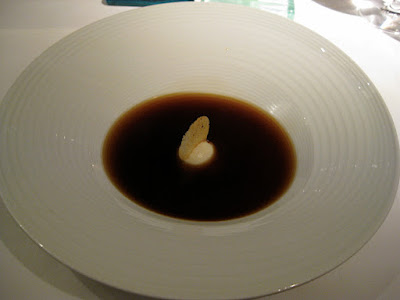
A second soup follows, and it is one of the most inspired, pure dishes you’ll find anywhere. Fundamentally, it is French onion soup, but it is reinvented here in the best tradition of culinary imagination. In the middle of the bowl, a scoop of gruyere custard that rests on top of a puree of caramelized onions. Jutting out is a translucent slice of toasted bread. This is bathed in a sea of beef bouillon that has a subtle gruyere flavor to it. A common, always-comforting dish takes on a refined quality with deeply concentrated flavors.

From Tru


Tramanto’s Italian side shows in the third course, a potato gnocchi with the texture of pillows, complemented by sautĂ©ed spinach, a hint of caraway, and a mustard crème. The supporting ingredients are relatively subtle, allowing the triumph that is gnocchi perfection shine through.

From Tru


The next three courses were remarkable for an interesting reason: the one that stood out, on paper, was the most pedestrian. First, a diver scallop topped with a slice of seared foie gras. Foie gras needs a sweet complement, which the scallop provides naturally. It’s a marvelous combination, given earthy undercurrent from white bean puree and bubble of smoke gel.

From Tru


Second was the standout: poached salmon. That’s right. Salmon. The fish was cooked in olive oil and displayed none of the dull flavor and pasty texture of farm-raised salmon. It came with long shavings of daikon radish and a star-shaped piece of granny smith apple. It sat in a refreshing, light broth flavored with granny smith apple and a touch of coconut milk. It was a delightfully uplifting dish, perfectly prepared, that cut the richness of this trio of courses. Smoked trout roe added a salty touch, giving a final confirmation that this preparation was one of the most delicious and creative ways to present fish in recent memory.

From Tru


Third came an easy crowd pleaser, executed beautifully. It was a piece of rib cap — the fatty, marvelous outer edge of the ribeye — wrapped in prosciutto, served on top of a finely cubed Yukon gold potatoes prepared in a risotto style. The sauce was a simple reduction, enhancing the more delicate flavor of the rib cap, that provided a smoky edge (common on this meal) from paprika. On the side, a bit of whipped raclette that, when eaten with the potatoes gave the impression of a terrific gratin.

From Tru


The remainder of the meal was a bit of a winding down, trying to balance the intensely rich main courses. But that soft landing commenced only after the cheese course, which arguably is unmatched at any restaurant in the country. Each person gets to choose a handful from a selection of about a dozen cow’s, sheep’s, and goat’s milk cheeses. They’re marvelous examples of craftsmanship, each delicious and refined. It is a course to be savored and celebrated. Tru’s generosity in presentation and service is laudable.

From Tru


To cleanse the palate came a “kir royale” in the form of a champagne granite and cassis gelĂ©e. It set the tone for a refreshing end to the meal. The dessert, not the expected chocolate decadence of Gale Gand, was a marvelous ode to passion fruit, featured in a sorbet and sponge cake and complemented by white chocolate, two small slices of naval orange, and a touch of vanilla. As an added bonus, the kitchen sent out a root beer float. No gimmick, no interpretation. Just a plain old root beer float that was terrific, sending you into the mignardises refreshed and surprisingly not feeling heavy.

From Tru


From Tru


To close, a special note on the wine. Chad Ellegood, the wine director, has a gift when it comes to the most difficult job of a sommelier. He can translate descriptions of wines the customer likes into a bottle on his list that matches both personal preference and the menu. It’s no easy feat. On this night, Chad outdid himself, pairing a subtle, stony white Burgundy with the first half of the meal and a stunning, remarkable red Burgundy with the second.

From Tru


The Maison Leroy Meursault 1er Cru Charmes 1999 steamrolled across the palate but maintained a distinct elegance about it. This enabled the wine to complement the lightness of dishes like the frog leg and watercress while providing enough power to stand up to the strong flavors. It was a white wine with balance, class, and strength. A masculine sensibility in a feminine profile.

The other wine was Domaine Leroy Clos Vougeot 1999. From the very first whiff in the glass, it was a treat and one of the best wines I’ve ever drunk. The elegance, balance, and stunningly velvety texture rode a wave of immense power. The red cherry fruit, sometimes veering toward cherry pie, lit up the palate, carving a boulevard down your tongue that allowed a world of complexity to follow. The long finish left a wake of fruit from the wine that twirled again into the sea of complex flavors. There was nothing simple about this wine, yet it was so eminently drinkable.

Both these bottles served as a stark reminder of the remarkable compatibility of food and wine. They are indispensible table mates, as at ease with one another as Joe Morgan and Dave Concepcion turning a double play. The entire experience at Tru is one of practiced ease. Eating there allows you to be in the presence of people who are good at what they do, know it, have practiced it, and retain their passion for it.

From Tru

Monday, May 25, 2009

Amuse bouche: When good restaurants go bad

A couple friends have had negative experiences at favorite restaurants recently. This brings up an important question: What should a restaurant do when it screws up? Regardless of whether the establishment is somewhere you frequent, any proprietor should see to it that mistakes are swiftly corrected. Give you complementary dessert; comp the entree; toss you a gift certificate for your next visit. No matter what the restaurant and no matter what its price level, it ought to do something when they mess up. Sadly, it is all too common that when dining out mistakes beget little more than a grudging apology. The worst example I've experienced was at t'afia in Houston. A lamb entree ordered medium rare came out medium well or well done three times. Barely an apology. Nothing comped. When that happens, you have to wonder if it's so common the staff is numb to it. My response is taking my business elsewhere.

Wednesday, May 20, 2009

Wine of the moment: Brancott Sauvignon Blanc Marlborough Reserve 2008

New Zealand Sauvignon Blanc provides some of the most delicious, refreshing, tropical-tasting wines, usually at a bargain price. There's nothing better for summer, especially in Houston, where summer feels like being deep-fried in humidity. The Brancott Reserve 2008 is a textbook example of everything that's right about New Zealand SBs: citrus and tropical fruit, with a juicy edge to it, bright acidity that cuts even the most searing summer heat, and a finish that is clean and sails on. That's all for the bargain price of $14.49 at the Spec's downtown. This wine is reminiscent of Cloudy Bay in its heyday (although the 2008 Cloudy Bay sure is rocking, too). The ideal wine for summer -- and for anyone who is just starting to get into wine and wants something pleasing and easy to drink.

Tuesday, May 12, 2009

Eating well at home

Guilty pleasures are not something to be ashamed of. The new 90210, for example. Real Housewives of Orange County. Rock of Love with Bret Michaels, or, how I learned to love a stripper. For the food-oriented among us, guilty pleasures probably include Gordon Ramsay’s Kitchen Nightmares. While the BBC version qualifies as legitimate entertainment, the U.S. version, on Fox, is pure guilty pleasure. There is nothing wrong with occasional indulgence. Leave it to Fox to reduce a technically proficient chef to a caricature of his already colorful self. This tarted-up yet entertaining hour is like watching Mark McGwire on double the steroids.

No, there is a point here. Regardless of the cartoonish version of Gordon Ramsay shown in Fox’s Kitchen Nightmares, one of his core messages given to the restaurants on the program that is something home cooks should take to heart. This will be our starting point.

1. Simplify

On Kitchen Nightmares, simplification means cutting down the size of menus. At home, simplification essentially equates to cutting down the number of ingredients. That is, there is a tendency to add to a dish in order to fix it. Everyone has been guilty of this. I remember, years ago, tasting tomato sauce I had made, not quite liking it, and adding a litany of spices, chili powders, and the like. What the sauce needed, most likely, was just a little bit of salt. No, we are Americans, our reflex is for more. Bigger portions. Pushing the limit. We want five-pound burgers with twenty slices of cheese, a two-pound bun, a whole onion, dozens of pickles . . . no, in this country, we don’t have a concept of “enough.”

But when cooking at home, it is simplicity that acts as an essential guiding light. Subtraction is the road to flavor. Food Network has been a culprit of addition. Have you ever seen Guy’s Big Bite with Guy Fieri? A recent episode showed him make a frittata, which included, well, everything that might be considered Spanish or Mexican. Then, he popped it out of the baking pan, covered it in about a pound of cheese on each side, and sandwiched it between two large tortillas, creating a frittata quesadilla. Disgusting. Why not just let quality ingredients speak for themselves? Why create a mess of conflicting flavors — peppers, chorizo, onions, garlic, cheese — and top it off with the rich, overbearing flavor of cheddar cheese and crunch of tortillas. Instead, it would be better (and less confusing to the palate) to take away the gooey, crunchy mass of quesadilla coating the outside and let the flavors speak for themselves. It sounds counterintuitive to conventional wisdom, but subtraction in cooking actually is addition.

Jacques Pepin, in his terrific cookbook Chez Jacques: Traditions and Rituals of Cook, discusses the “perfect meal.” He writes, “The meal is roast chicken served with a salad and boiled potato. It is straightforward, simple, and good when done properly . . . .” This meal incorporates a total of only ten ingredients: chicken, salt, pepper, white wine, chicken stock, lettuce, olive oil, red wine vinegar, potatoes, and butter. Eating this, you cannot help but be stunned by the depth and purity of the flavors. Watching friends have it for the first time, you can see them rediscovering the pleasure of simple food with each bite.

The basic point is this: you can add all the ingredients you want, but you aren’t going to develop compelling flavors unless you take the time to develop those flavors. It is better — and so much easier — to take a few flavors and truly develop them. Reduce cooking liquid enough to concentrate it. Buy a better quality chicken, cook it with care, and coax out the natural flavors. This might be asking too much of a society that goes for quick fixes like breast implants and the microwave. Dare to dream. Embrace simplicity, and it might help you with the second key for home cooks.

2. Comfort equals confidence

A dear friend recently said she thought cooking well at home was about confidence. The more comfort you gain with dishes, the more comfortable you got, and the better you can cook. This is profoundly true. Mastering basic techniques, simple combinations of ingredients, and executing them as skillfully as possible is a logical progression if you think about it. Platitudes provide reasonable support here: Run before you walk. Failure is not an option. Always give 110%. This merely is a controlled burn.

In other words, maximize your chances of success. You’re not going to dive into cooking and crank out homemade croissants or sweetbreads without building up to it. Unless you’re Julie Powell. Or insane. The basic point is that cooking, like anything else, is about starting with simplicity (see No. 1 above) and building up to more complex levels. For some reason, people often decide, “I want to cook,” so they begin by inviting over six or eight of their closest friends and try something new ambitious. Yes, do that . . . except the exact opposite.

3. So where do I start?

When you eat at home, you spend less on food and you eat more healthfully. You don’t get the added salt and fat from restaurants that are trying to impress you and put their best foot forward. That’s great sometimes but not feasible for an everyday existence to maintain something resembling average weight. So here’s an easy recipe that you can try one weekend to have a healthy, home-cooked meal that will build up your confidence. The chicken roasting method is that of Jacques Pepin. It is masterful. The salad is adapted from his recipe.

From Roast Chicken


Roasted chicken with green salad
1 chicken, whole, 3.5 pounds
Salt
Pepper

1 head of Boston lettuce (or, really, any lettuce)
1 tablespoon red wine vinegar
3-4 tablespoons olive oil
Salt
Pepper

½ cup white wine or dry vermouth
½ cup chicken stock
1 shallot, minced
Salt
Pepper

From Roast Chicken


Preheat your oven to 450 degrees. Dust the chicken on all sides with salt and pepper. Put the chicken in, ideally, a large iron skillet (with a touch of oil in the bottom to keep the skin from sticking) or a low-sided baking or roasting pan. Place the chicken on its side. Roast for 20 minutes. Take it out of the oven, baste lightly with its own fat and juices, and turn over the chicken to its other side. Roast again for 20 minutes. Take it out, baste, and put the chicken breast-side up (the usual roasting position). Roast for a final 20 minutes. There. You have a perfectly roasted chicken. Take it out of the skillet and put it aside on a cutting board and let it rest while you make the sauce.

During the final 20 minutes of roasting, prepare your salad. Pull the leaves of the lettuce off whole, discarding any that are wilted or brown or otherwise undesirable. Fill your sink with plenty of cold water. Rinse the lettuce in the sink; this allows the dirt to sink to the bottom and not stick to the leaves. Dry lettuce in a salad spinner. Put the leaves in a large bowl, tearing them into smaller pieces if you prefer. In a small bowl, add the vinegar and a bit of salt and pepper. Vigorously whisk in the olive oil. Taste and adjust the season accordingly. Add more vinegar or more oil for the desired tartness. Don’t dress the salad just yet.

With the skillet you roasted the chicken in, pour off all but a film of the rendered fat. Set this extra fat aside. Over medium-high heat, briefly sweat down the shallot. Add the wine, scraping up the browned bits of juice from the skillet. When the wine is almost all gone, add the chicken stock, salt, and pepper, as well as a tablespoon or two of the reserved chicken fat. Taste. Always taste! Adjust the seasoning, if necessary. Let the sauce simmer for a few minutes, while you cut up the chicken.

After the chicken is cut and put on a platter, pour over the sauce. Then, immediately, toss the salad with the dressing. Drizzle over a tablespoon or two of the chicken fat, allowing the flavors of the salad to marry with those of the chicken. Serve.

With about 20 minutes of active preparation time and perhaps 90 minutes of attention, you have a terrific, easy, healthful meal. This is the perfect roast chicken.

A note on cooking time: The recipe calls for a 3.5-pound chicken. What if you can’t find one? What if it’s 4 pounds? No matter. The cooking time is proportional. If it’s 60 minutes for 3.5 pounds, then 4 pounds requires one-seventh more cooking time, or roughly 8.5 minutes. Adjust each segment of cooking according – so, roughly 23 minutes before each turn.

Wednesday, May 6, 2009

Amuse bouche: A pet peeve on restaurant wine prices

You could go on for thousands of words about how much restaurants have let down their customers with their wine programs: high prices, limited selection (particularly in Texas), lists that bear no relationship to the food on the menu, etc. One complaint, however, jumps to the forefront. It's the price of wine by glass. Recently a friend went to Textile, which will be reviewed here later, and found a glass of Becker Iconoclast Cabernet Sauvignon for $12. Something didn't sound right about that, and it wasn't. Spec's here in Houston sells it for $8.29 a bottle. The winery sells it for $10.95 a bottle. So $12 for a glass? When the restaurant gets to purchase at wholesale prices? The only applicable word is outrageous. Making back the wholesale cost of the full bottle on the first glass alone? This has become, sadly, a common phenomenon -- restaurants charging the price of a bottle (or more) for a glass of wine. There's no reason for that. When there are prices like that on a wine list, go with water or iced tea instead. They don't deserve your business.