Monday, August 24, 2009

Review: The French Laundry

The French Laundry has a tough job these days. Its reputation is so established, legion of fans so large, and margin for error so non-existent that it’s an easy target. Food is a deeply personal thing. A restaurant can be even more so. Chefs, like writers, put forward an intimate, creative side of themselves for public judgment. If that’s the case, then Thomas Keller is the cooking equivalent to Phil Jackson coaching in the NBA finals. He just doesn’t lose. He takes what he’s given, adapts to it, gets the absolute most out of it, and leaves you astonished.


The French Laundry is a restaurant that doesn’t let you down. It is the place that encompasses the evolution and ascendancy of restaurants in the United States over the past forty years. It harnesses the power of Alice Waters’ emphasis on fresh, seasonal, and local ingredients, couples it with the very best in formal service with an influence of American casualness, and incorporates an elegant dedication to classicism for the food and décor. In short, the French Laundry is the restaurant that tries — and succeeds — at pleasing everyone. Or at least coming close.


Two recent trips to the French Laundry confirm this is the best restaurant in the country. Period. But to bestow such a sweeping superlative on the place undermines the true pleasure of the experience. Make no mistake, though, a meal here is a pure luxury. At $240 (service included) for a nine-course tasting or nine-course vegetarian menu, you’ll be lucky to make it our for less than $500 per person once wine comes into play. But it is the meal, if you have deep-seated passion for food, you owe to yourself at least once. Give up your Starbucks or Chick-Fil-A habit for a year. You won’t regret it.


The first impression of the restaurant is how unassuming it is. You won’t notice it if you just drive down Washington Street in Yountville. Inside, the restored building is magnificent. Refined rusticity might have been invented here. The tables reflect the restaurant’s name: crisp, white linens; the napkin secured to white plates, shimmering from the soft light given off by wall sconces, with an old fashioned laundry pin.


For an establishment that attracts such zealous lovers of food, the atmosphere is so relaxed and unhurried, you can’t help but feel at ease. It’s a remarkable feat, really, considering the ratio of servers to diners. With room for about sixty customers, the two-story dining room also accommodates seemingly forty staff. The remarkable thing is you can’t really tell how many servers there are because they are simultaneously ubiquitous and invisible. To create a pleasant, quiet environment while lavishing each table with attention is a remarkable feat. The only potential issue in the dining can be temperature: in the summer it can be stuffy, compounded by the jacket requirement for men.


Really, though, it is wasteful to spend so much time on the “experience” of the French Laundry because the last thing it aspires to be is an “experience” place. Nothing distracts from the food. The dining room isn’t flashy. The service, while impeccable, takes a back seat. This is all about the food, but recognizing the unmatched efforts that come from everyone at the restaurant would detract from the marvelous, leisurely perfection of a meal at the French Laundry.


The starter rarely changes: two amuse bouche, the cheese gougeres and salmon tartare with red onion crème fraiche in a sesame tuile. This is an important first step. The gougeres show remarkable execution of the pastry, while allowing the gruyere to shine through clearly but not overwhelmingly. The salmon “ice cream cone” is legendary for good reason. It’s refined, playful, and delicious. The red onion crème fraiche provides a refreshing burst, and the tuile is so delicate you wonder how it can support the weight of the teaspoon of salmon. These are classic amuse, executed marvelously and betray that you are in for a treat.


The first course also usually is the same: “oysters and pearls.” It’s essentially decadent tapioca pudding, delicate and flavorful with no shortage of butter. Two lightly poached oysters sit on top, with a generous dollop of California caviar. With Champagne, this dish simultaneously transports you to the good life and makes a resounding case for simple cooking. And the domestic caviar is a testament to efforts in this country to develop top-quality ingredients.


Next up is foie gras, if you choose, or a salad. The salad is always interesting and generally made from fruits or vegetables grown in the French Laundry’s garden, which sits across the street. The foie gras is well worth the $30 supplement. A terrine of pillow-like softness and elegance is enhanced by a celery branch and tart rhubarb that cuts the richness. Toasted brioche — a warm piece traded out for a fresh warm piece a few minutes later — leaves you smiling, another classic executed perfectly. The theatrical replacement of the brioche partway through the course is handled so matter-of-factly that it diffuses any possibility of pretentiousness.


Third is the fish course. On the March visit, sous chef Corey Lee’s influence showed in a brilliant Japanese big fin squid dish, with pasta, green garlic, chorizo, sweet peppers, Spanish capers, and Swiss chard. You know the French Laundry can cook any piece of fish, and one of the choices will showcase that, but this squid showed such imagination, with the earthy kick of capers and chard to complement the fresh (and not tough) squid and slight spice of the chorizo. A dish ordered out of a desire to sample everything on the menu became a memorable standout.


The first half of the meal rounds out with the lobster course. Normally you get mitts or tail poached in butter. Occasionally, they’ll be poached in olive oil. There is an inherent risk of lobster being slightly chewy, even at the best restaurants, and that was the case on one visit. But the complements in the spring — avocado, radish, fresh fennel, and niçoise olive — came with a cool citrus broth that allowed the lobster mitts to be a vehicle for a refreshing, invigorating dish.


The meat courses rotate frequently. Chicken, pork, duck, beef, veal, and lamb all make appearances, in various cuts and preparations. Duck is a particular treat. This March, a duck breast served with English peas, turnips, mache, and intense black truffles made for a dream pairing with red Burgundy. As with each course, the individual ingredients shine through beautifully and complement one another; there isn’t interference. These flavors work together and aren’t shouting over one another, competing for the spotlight.



It’s at this point in the meal that you wish the French Laundry offered wine pairings. The rationale for only offering the wine list is that the menu changes daily, so keeping up with pairings would be arduous. The reality is that, while the menu will change daily, there is a spectrum of dishes the kitchen works with. Flavors change, but the core of the menu is constant enough to allow a course-by-course pairing. It is the one way the meal could be taken to greater heights, not that the wine list lacks in selection that’s perfect for the food.


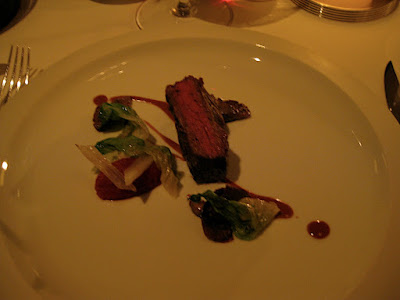
The beef course on both visits was the cap of the ribeye, roasted to medium rare. Deeply flavorful and with the fat melted in, it’s a delicious canvas for bluefoot mushrooms and a San Marzano tomato compote that, after you finish relishing the intensely pure flavor, you realize is essentially the best ketchup you’ve ever encountered.


The cheese course always is a simple affair, showcasing a single cheese that is worthy of solo attention. It is followed up with a sorbet or sherbet. After the richness of the middle section of the meal, a buttermilk or fruit sorbet is just the ticket, like the acidic backbone of a wine keeping your palate refreshed. Buttermilk sherbet with sour cherries and a black tea foam — showing you foam may be passé but not necessarily boring or uninteresting when properly prepared and used — emphasizes how the menu plays with sweet and savory, refreshing and rich, and the earthy side of food.


Dessert tends to walk the classical line, with chocolate mousse that reminds you why classics are just that, or lemon parfait that hits tart and sweet notes with equal force. So skillfully executed, it makes you feel like a kid again, bringing back memories of timeless favorites.


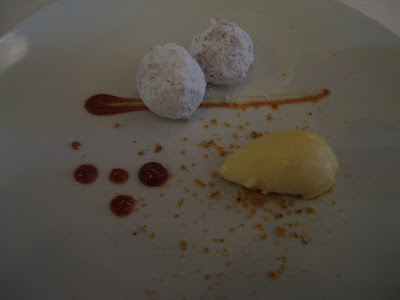
There's also a secret at the end of the meal. Ask if they have any "coffee and doughnuts." They do. But you have to ask. If they're available still, you will get the most delightful cinnamon sugar doughnut and espresso semifreddo.


The French Laundry isn’t a meal that reads well. It’s something you must experience to realize the sheer perfection and enjoyment of it. Nothing is out of place. There are no missteps. Needs are anticipated; requests are met immediately. When a restaurant approaches every day with impossible expectations, it’s remarkable enough for it to meet them. At the French Laundry, Thomas Keller has assembled a brigade that routinely blows those expectations out of the water. There is no better restaurant in the country. Few even come close.

Wednesday, August 19, 2009

Amuse Bouche: Guilty pleasure

Canned nacho cheese at the Astros' game. 7-Eleven spicy bite hot dogs. Hostess cupcakes. Fried turkey legs at a county fair. Chex Mix. Soft Batch cookies. Jimmy Dean sausage biscuits, fresh from the microwave. Taco Bell Meximelts. Everyone has his delicious-yet-embarrassing food secret. Is it some connection to childhood that does it? Some crack added during the process that creates trans fat? Whatever it is, perhaps a connection of some kind to childhood (well, maybe not for the Double Whopper), these guilty pleasures exist, just like reality television on VH1. Anyone want to top my inexplicable cravings for lukewarm Chick-Fil-A nuggets off of their catering trays?

Tuesday, August 11, 2009

In re Lankford Grocery

Before the Burger Court of Houston, Texas
Docket No. 2
IN RE LANKFORD GROCERY AND MARKET
HEARD JULY 14, 2009
DECIDED JULY 29, 2009

Before GUTTING, BRINKMANN, LAHAD. for the court filed by GUTTING, J, in which JJ. LAHAD and BRINKMANN join.

GUTTING, J. Before the court is the submission of Lankford Grocery and Market of Houston, Texas (“Lankford”). A long-time leader in the Texas burger culture and recently recognized by Texas Monthly magazine as the 39th best burger in the state, a recent circuit split has emerged regarding Lankford. To resolve this dispute in extremely important area of burger law, we granted certiorari.


We hold that Lankford provides an exceptional burger, worthy of special effort to seek out and enjoy, and merits an A rating. The opinion of the Texas Burger Guy is affirmed; Alison Cook's Burger Friday review is overturned and cited as erroneous precedent.

Background
Lankford is a shack in a strange corner of mid-town, surrounded by new townhouses that should only be so lucky to reach the age of the Lankford building in any shape at all. Inside, you always get the feeling Lankford might come falling down on you at any moment, leaving you to find the most convenient escape route that also will allow you to emerge with a burger in hand.

There's no lack of local color about the place, and the burgers reflect a simplicity that is so easily forgotten in this day of American kobe burgers and sliders. You can go single or double. Maybe some chili. Perhaps the Soldier burger with its fried egg on top. Nothing fancy. Everything delicious.

The Court reviewed three burgers: (1) a double with cheese; (2) a double without cheese; and (3) a Soldier burger.

The Hamburger
These burgers were glossy, sexy pieces of ground beef. The moment they arrived, fresh off the griddle and projecting steam, you could feel as if something magical might be happening this day. An initial sample of the patty alone heightened expectations and senses even more: juicy, rich, an archetype of what a burger should be. Not too much salt. Not too much seasoning. Just the purity of beef that is too often lost by purveyors who don't have the courage to stand on the quality of their ingredients alone.


The patties are hand-formed and roughly a half pound. The double was a candidate to give diners lockjaw due to its height, which was enhanced by a stack of lettuce, tomato, and chopped onion. On the cheeseburger, American slices oozed nicely, but the hamburger also seemed as juicy overall. The Soldier burger achieves a mayonnaise-like quality to its toppings with the over-easy egg. There were plenty of pickles on each patty, a welcome thing with such pure beef flavor. Mayonnaise was appropriate, and the mustard -- too often prone to taking over and dominating the flavor -- used judiciously. Too many burgers suffer from excessive mustard. This is a hamburger, not a musburger.


The burgers came out a barely medium-well, with plenty of retained juice and no signs of dryness-inducing griddle-pressing that lesser establishments insist upon to speed cooking. A solid crust formed on the outside of the patties. These were burgers that begged to be eaten. This was ground beef in excelsis, enhanced by light salt and pepper.

The bun isn't artisan or fancy. This is the style of bun that is meant to create a neutral canvas for a burger, and it can be used to excellent effect in a case such as this, where the meat needs no supporting cast. Bun integrity was strong on the double burgers. Perhaps they are a touch airy for some, but this was not a detriment in the opinion of the Court.

Sides
On this day, the Court declined to hear evidence on side dishes. We deemed the Circuit split to be of such high importance that all efforts must be concentrated on strict scrutiny of the burgers themselves. In accordance with our prior precedent, see In re Mel's Country Cafe, supra, we decide the case of Lankford Grocery on the merits without consideration of side dishes. The Court does take judicial notice that Lankford's fries are generally average to slightly above average, while their onion rings are above average.


Extras
The Court would like to make special mention of the cherry cobbler ordered this day. While the issue of cobbler need not be reached in order for the Court to render judgment, this cobbler cannot go without discussion. The Court expressly notes its willingness to dismiss with prejudice any claims of merit advanced by the Lankford Grocery cherry cobbler, which contained precisely one cherry in an entire bowl that more resembled a Hostess fried pie crumbled up and put in the microwave. This abomination is unworthy of an establishment of Lankford's stature.

Conclusion
Lankford Grocery produces a burger that is worthy of Best In Houston consideration. It will be difficult for any restaurant to top the merits of this burger. As a result, we award Lankford an A grade. The opinion of the Texas Burger Guy is AFFIRMED. The opinion of Alison Cook is OVERRULED and the case remanded to her for further proceedings consistent with this opinion.

IT IS SO ORDERED.

LAHAD, J. concurring. I concur in the holding announced today but write separately to admonish Lankford Grocery's appalling cherry cobbler. While none of the parties in the case at bar moved to sanction Lankford, and my brethren on this Court persuaded me that it would be unnecessary judicial activism to act sua sponte, the cherry cobbler offered by Lankford would warrant hefty sanctions and possibly a contempt order. As an officer of this Court, Lankford has a duty to provide accompaniments that meet both gustatory and ethical standards. This alleged "dessert" fails to meet either; Lankford's cherry cobbler is, simply put, the pits.

Tuesday, August 4, 2009

Review: Textile

Textile opened in Houston last fall to much fanfare. Scott Tycer has garnered an ardent following here, and Textile is intended to be his crowning achievement. This was to be the restaurant at the top of the city's fine dining scene; a legitimate destination at the high end, something Houston sorely lacks. Is it? The answer is full of qualifiers: Maybe yes, but, if yes, then only in one respect. It will take some doing to explicate that answer, and perhaps the lack of a simple answer should indicate the true answer itself. But there is one area in which Textile succeeds in throwing Tycer's hat into the highest echelon of chefs: price.


Textile is spendy, and it's worth taking some time to discuss that. By virtue of price -- $85 (plus $55 for wine) for a five-course tasting and $115 (plus $75 for wine) for seven courses -- Textile is playing in the big leagues. Prices for non-paired wines, though mostly well-selected, are exorbitant. (The list at Gravitas always seems to have a couple $10 bottles for $45+, implying wine-as-profit-center is a Tycer tradition.) That means big league expectations and razor-thin margins of error. You can go to Tru in Chicago, for example, and have their eleven-course Chef's Collection for $135. The $125 to $175 price range is fairly standard for degustation menus at the top restaurants in San Francisco, Los Angeles, Chicago, and New York. So $115 in Houston, with our lower cost of living, is a bold move. It's a price that allows no room for disappointment or average or lapses in execution when it comes to food or service.


The space at Textile is lovely. There is a calm, cool feel about the room, and the kitchen and service areas are removed, keeping even the usual bustle from reaching the dining room. It's a pleasant atmosphere and is a key contributor to the experience at Textile feeling more enjoyable than just the sum of its parts. It’s relaxed, not stuffy or aloof.


At a restaurant like this, however, ambiance and service must be a given. It cannot get by on anything but the strength of its food. And this is where Textile falls down, excepting the dessert discussion below. Purely in terms of food, this isn't one of the top five places in Houston. It might not even be in the top ten, but that may be a result of sticker shock. The creativity is interesting at times in Tycer's food. The execution is maddeningly inconsistent, reminiscent of the same struggles Robert Gadsby has at Bedford.


The meal started with a solid dish of pickled white asparagus with dilled kefir. It was a crisp, tart, and refreshing opening, paired beautifully with the citrus-tinged and creamy Nicolas Feuillatte Blanc de Blancs NV. But here began the rollercoaster ride.


The second course was unforgivable: bay scallops and wheat pasta in a celery broth. The scallops were not fresh, with an intensely fishy flavor that screamed of being a couple days' old at least. This sin was amplified by the neutral celery. The pasta was al dente but had an odd, soft, almost slimy feel on the outside, as if it had been cooked short and left to sit and never properly reheated. Whatever happened with this dish was a mistake. Mistakes can happen. They can be corrected. But at a restaurant with Textile's aspirations? A plate like this never should have reached a customer. It indicates a failure of execution in the kitchen and quality control. There was, at least, a surprising and superb Meroi Pinot Grigio 2007 to sip until the waiters cleared the plate.


From that low, the meal reached its apex, an inspired smoked kielbasa with pork belly and goat’s eye bean. The sausage was excellent, meaty and flavorful, complemented by the succulent richness of the pork belly. It was easily the best dish of the night, and it had the best wine of the night, as well, Bergstrom “Dr. Bergstrom” Riesling 2006 from Oregon. It was a real surprise and made this inspired course a great domestic representation of food with such a German feel.


Then the inconsistency resurfaced for the next two dishes. First, quail stuffed with sage bread pudding with porcini and summer truffles. The stuffing was light and airy, but its quantity overwhelmed the subtle quail meat, and the sage neutralized any hint of truffle. The flavors didn’t coalesce. Not even the tasty Faiveley Bourgogne 2006 could bring out any hint of truffle in the dish. Second, a roast leg of duck with forbidden rice had a lovely, crisp skin, but it was overcooked and dry. The forbidden rice was mushy, with a texture like refried beans and with none of the nutty flavor it should have had.


A refreshing cherry and gianduja float preceded the dessert, honeydew and melon soup with goat cheese and brioche. It would have been a refreshing cap to a quite rich string of dishes, but the soup came out room temperature, not chilled. The flavors fell a bit flat.


The dessert, which must have sat too long waiting to come out of the kitchen, underscored the deep problems with service at Textile, an all-too-common problem in Houston. The waiters were awkward and seemed uncomfortable and hot. Each course delivered to the table -- a five-course and a seven-course -- was flip-flopped. Even after being brought to the attention of the maitre d', it continued through the meal's conclusion, reaching the point of being laughable. Wine service from sommelier Frank Moore, though, was superb. He is a knowledgeable, passionate wine steward whose pairings generally are smart and appropriate. His trips to explain each pour were a highlight of the evening.


So far, it is hard to reconcile all this with the "maybe yes" answer above. Isn’t Textile just overrated and overpriced? Well, yes. But it also has Plinio Sandalio, the pastry chef. What is clear about Textile is that it is the best restaurant in Houston -- for dessert. And it does have the best chef in town -- Sandalio.


The dessert tasting at Textile, offered Tuesdays and Wednesdays, is the thing to get to find value and inspired creativity. It is a glimpse at special and rare talent over eight courses.


To start one recent evening, out came two crisp matchstick French fries, with a dollop of potato chip-crusted mayonnaise that was deep fried. It showed that, in this frying-crazed era, there are still interesting things to be discovered.


The tasting itself was split into savory and sweet halves. The savory began with the much-ballyhooed “corndog”: a slightly sweet corn fritter, mustard ice cream, and ketchup with ground hot dog into it. Each element was tasty, but the flavors melded together in impressive harmony that worked in conveying the best of sweet-salty-savory interplay. Less successful was the okra ice cream and andouille caramel that followed. The ice cream was delicious, something like creamed okra, but the andouille caramel didn’t quite gel.


The savory segment closed on another high, a lemon tart with candied olives. The olives, the harshness of their flavor eviscerated, made an interesting pairing with a superlative lemon tart. This showed Sandalio at his greatest skill and gave a glimpse at a possible weakness. The tart shell was exquisite, light and crisp. The lemon filling was perfectly executed and avoided the pitfall of so many lemon desserts, which become too sweet and mask the lemon flavor. Not here. It was piquant and captured a juicy lemon’s refreshment. Sandalio’s fundamental skills are without doubt; he ensures that you can see all the classical techniques he has mastered, giving him more leeway to be creative. With this dish, however, the olives seemed superfluous and unnecessary. They were interesting, but you can’t help but wonder if one fewer element would have given the overall dish a greater stature. With his skill, however, you are likely to write it off as minor.


Between the savory and sweet halves came a watermelon and feta “intermezzo.” The compressed watermelon was crisp and ripe. A small feta cheesecake opened your mind to new dimensions of the line between savory and sweet.


The sweet segment showcased Sandalio’s creativity within more a more traditional realm. The coconut cake was delicious and perfectly executed, although the accompanying avocado ice cream, while nice texturally appealing, brought out an odd side to avocado’s earthy flavor. The peach sorbet was the essence of a favorite Texas summer ingredient, and the white chocolate mousse maintained elegance. This dish actually seemed somewhat out of place it was so traditional, though perfectly executed.


The last course was a substantial bittersweet chocolate torchon, filled with cherry and complemented by “pop rocks.” As a cherry cordial, it didn’t quite work, and it was rather heavy, but the chocolate was beautiful. There’s no denying the skill that went into the dish.


The final touch, a series of mignardises, left a lingering impression of Sandalio’s impeccable skill in the kitchen: a perfect hazelnut tart, sumptuously rich brownie, and shortbread that will make you spontaneously renounce all others. And that, in essence, is the contrast between Textile at dinner and at dessert. The main courses suffer from lapses in execution and occasionally questionable choices, such as the superfluous black truffles on the quail. At dessert, it’s a bit like watching Jimmy Page play the guitar. All the fundamentals are there, and you’re constantly aware of that basic skill, but you’re always teetering on the edge of disaster in a flurry of creativity and experimentation. It makes the food fun, but it only works because Sandalio hits more than he misses.


As a result, the lingering impression of Textile is mixed. You want to like the place more than you intuitively should. The atmosphere is pleasant. The wine pairings are thoughtful and appropriate. For every miss of a course, you’re reassured by the atmosphere. And you get the wonderful memory of the desserts. So the bottom line requires sober reflection. At easily more than $200 a person for the seven-course tasting with wine, $140 for the five-course with wine, and limited a la carte selections, liking the place doesn’t make up for relatively uneven food. Overall, it’s a welcome addition to the Houston dining scene because it’s serious. But the prices need to reflect the reality of the food (and, perhaps, the economy) or sloppy execution and service must be stamped out permanently. In the meantime, take less risk and go on a weeknight for the a la carte selection or go ahead and have dessert for dinner.

Wednesday, July 29, 2009

Tales of Excess: Chicken fried prime ribeye burger

We fry everything in this country nowadays, especially in the South. Eating head shaking fried food has become the new test of a peculiar brand of manhood. Go to any county or state fair, and you have a litany of preposterous fried items: Snickers bars, bacon, Moon Pies, Twinkies, macaroni and cheese, and Coca Cola all get a batter bath and take their place next to your side of fries. In that spirit, the recently convened Burger Court of Houston, Texas, held its usual private conference to discuss petitions for oral argument. On the menu? Burgers, naturally.

From Meatfest of the Burger Court


When the Burger Court convenes, even for a simple conference, the usual fare is a steakburger made out of ground, USDA prime strip steak or ribeye. In the grinder also goes a bit of bacon or pancetta for added fat and moisture. At the most recent meeting, however, a motion came before the Court that the Justices consider a chicken fried burger. Flour, Kosher salt, and a bottle of Shiner Smokehaus being on hand, the Court -- unanimously, sua sponte, and without written opinion -- elected to engage in open-minded judicial activism and hear the writ of mandamus from a fourth burger patty at risk of being orphaned after three were placed on the grill.

From Meatfest of the Burger Court


The batter consisted of approximately one cup of flour, a fair bit of salt, and the twelve-ounce beer missing two small sips. After a brief coating, the patty went into an iron skillet filled with one-and-a-half inches of grapeseed oil heated to just below the smoke point. Ten minutes and a brief drain on paper towels later? A golden, juicy, gorgeous indulgence. The crust was light and very crisp, adding a nice textural element to the bacon-tinged steak. It retained natural juices well, without being too greasy. It may have been less greasy than many burgers cooked on a griddle. No condiments necessary. But this is probably a burger best split three ways.

Due next on the Burger Court docket: Lankford Grocery.

From Meatfest of the Burger Court


From Meatfest of the Burger Court


From Meatfest of the Burger Court

Monday, July 20, 2009

Wine of the Moment: Remoriquet Bourgogne Haut Cotes de Nuits 2006

They say that, in wine, all roads eventually lead to Burgundy. One might take that as a metaphor for life, since all roads in life eventually lead to death. For the wine-crazy among us, Burgundy can spell the beginning of the end. Perhaps one day you are lucky and ill-fated enough to find your Burgundy epiphany -- a luscious, perfumed, cherry-laden wine that heightens the senses and haunts you. Your first great Burgundy is like reading the Russian masters for the first time; afterward you'll be chasing the high, never to be equaled, for the rest of your life. Love of Burgundy can also be financially perilous. While there is value to be had, prices range from spendy to astronomical. (The current release of Domaine de la Romanee Conti's Romanee Conti, for example, is in the $3,500 to $4,000 range per bottle.)

Still, even the threats of bankruptcy and alienating friends and family seem not to deter someone awestruck by Burgundy. There are options, however, that allow you to feed your Burgundy habit without ruining your life. It's like True Blood for wine drinkers. Most recently, I found Remoriquet's Bourgogne Haut Cotes de Nuits 2006. It's $22.49 at the downtown Spec's. A terrific red Burgundy (read: 100% Pinot Noir) that delivers a touch of funk, loads of sour cherry fruit, bright acidity, and a juicy finish on a refreshing frame. This is just the kind of wine that goes beautifully with the heavy food Houstonians prefer, even in summer.

Tuesday, July 14, 2009

In re Mel's Country Cafe

EDITOR'S NOTE: Burger Ipsa Loquitur, d/b/a The Burger Court of Houston, Texas, will be a recurring feature on the blog. Sitting by special designation, it brings together three deeply passionate and experienced burger lovers who are driven to find the best burger in Houston. An open-minded attitude drives these Judges, allowing them to focus on the Burger Due Process: strict scrutiny of the patty, bun, and condiments, while considering areas such as side dishes and restaurant atmosphere under a rational basis standard. Enjoy and, as always, comments are welcome.

Before the Burger Court of Houston, Texas

Docket No. 1

IN RE MEL’S COUNTRY CAFE

HEARD JUNE 14, 2009

DECIDED JUNE 17, 2009

Before GUTTING, BRINKMANN, LAHAD.

Opinion for the court filed by LAHAD, J, in which JJ. GUTTING and BRINKMANN join.

LAHAD, J. Before the court is the submission of Mel’s Country Café of Tomball, Texas (“Mel’s”). After dismissing Mel’s motion to dismiss for lack of personal jurisdiction,* this court proceeded to taste oral argument regarding the hamburgers at this “family owned and operated” establishment located in the more bucolic part of Tomball. We hold that Mel’s provides an average to above-average hamburger. That is, Mel’s burger warrants a B+ rating.


Background

Set in a wood and tin roofed structure across the railroad tracks on Stanolind Road is Mel’s Country Café. Touting homestyle cooking (read: fried) and weighty burgers, Mel’s serves up everything from bacon hamburgers to Cajun grilled chicken breast. Mel’s legend, however, was built on the Mega Mel Burger: 1.5 lbs of ground beef, 1 lb of bacon, 1/4 lb American cheese and “lots, lots of lettuce, tomatoes, onions, and pickles.” If you can finish the $20 Mega Mel in less than two hours, your name and finishing time will be inscribed upon the wall-of-fame along with countless other gluttons, including one allegedly human man who, it is written, finished this abomination of ground beef in 9 minutes. Yes, nine. Presumably, he watches other contenders try to beat his record – from heaven. The Mel burger, the Mega Mel’s younger and of course more attractive sibling, consists of 1 lb of beef, 1/4 lb of bacon, some cheese if you wish, and the condiments. The bottom-line is that at Mel’s, burgers talk, and everything else walks, or is fried.


From Mel's Country Cafe


The panel tasted three hamburgers: 1) a double cheese burger with all of the trimmings; 2) a Mel burger with cheese; and 3) a Mel burger without cheese or mayonnaise.


The Hamburger

If the burgers were judged on looks alone, the Mel burger would win the beauty contest. The Mel appeared with 3 1/3 lb patties between what looked like substantive buns. The bacon did not overwhelm the burgers appearance, nor did the vegetables hiding under the lowest patty. A large toothpick ran reassuringly through the middle to keep everything in place. But in the end, the Mel’s beauty turned out to be only bun deep.


The Mel’s patties do not appear to be hand-formed. If they are, then great skill goes into making each patty a clone of the preceding patty. The patties were well seasoned and had a nice crust on the perimeter. A nice char or crust on meat is an under-appreciated quality in burgers. Mel’s burgers succeed where many burgers fail: seasoning. Eating some of the ground beef on its own demonstrates that some care goes into seasoning the patty before cooking. Whatever the seasoning – probably nothing more than salt and pepper – it is applied in just the right proportion and preserved during the cooking process. Frankly, it was refreshing.


From Mel's Country Cafe


Speaking of cooking, Mel’s cooks its burgers to medium well. While this may be good for food-borne illness and even cooking time, in this court’s opinion, it dried the patties out. The Mel had three patties that were each too dry for their own good. This synergistic backfire resulted in a burger that was significantly drier than what one wants or expects from a place like Mel’s. This dry patty problem was common to all three burgers indicating a systemic issue, not just an isolated incident caused by a distracted cook. Reducing the cooking to only medium could remedy this.


Of course, one holds a hamburger by the bun. The bun was toasted and appeared ready to survive the meal, but in the end it couldn’t cut the mustard. Half-way into eating the burgers, the lower bun’s structural integrity began to fail. By the end, the lower bun had disintegrated into a soggy mess, probably from the vegetables. The patties were too dry, in this court’s opinion, to do that serious of damage to the bun.


Sides

While the appetizers and sides do not factor into the final calculus, a word should be said about Mel’s. First, they were all fried of course: Onion rings and stuffed jalapeño’s to start and French fries, tater tots, hush puppies, and fried okra to ride shotgun. Cheers to the onion rings – hand-battered and made from noticeably sweet onions. Jeers to the jalapeño’s – nearly expired fare from the nearest Sam’s Club. However, the real disappointed came in a small red basket lined with wax paper: the French fries. The fries appeared so synthetic and overdone as to be unappetizing. Mel’s would come dangerously close to a fair or merely average rating if the fries were a factor. They offended traditional notions of French fries and substantial sides. At some places, the fries are an afterthought. At Mel’s, there was no thought given at all.


From Mel's Country Cafe


Fortunately, the remaining three sides came to the rescue. The fried okra was fantastic as were the tater tots and hush puppies. In sum, I would join Alison Cook in lambasting Mel’s fries. That is how bad the court found them.


Extras

At $7.95, the Mel burger is a value. The other burgers and each of the sides were also quite competitively priced. Indeed, it would not be a stretch to call the food at Mel’s ‘cheap’. However, if time is money, then Mel’s burgers could be classified alongside Kobe beef burgers from a downtown bistro. Mel’s takes time. It takes time to get there. Once you arrive, you have to wait: wait to be seated; wait to get a server; wait to get your food (again, it would take less time to cook it to medium). Not surprising that one could finish a several sodas or glasses of white zinfandel while waiting for the main event.


Conclusion

In sum, the court finds that while well seasoned, the argument proffered by Mel’s Country Café does not provide sufficient evidence to meet the standard of clear and convincing deliciousness to be rated an A or A- burger. Mel’s dry patties and lackluster bun cannot carry its burden, no matter how pleasing the proportion of pepper (alliteration intended). Accordingly, Mel’s burgers are given a B+ rating.


IT IS SO ORDERED.


______________________

* Mel’s moved to dismiss on grounds that it did not have sufficient minimum contacts with Houston to be within the reach of this court’s personal jurisdiction. The Motion was denied based on substantial evidence of at least minimal, if not significant, contacts with Houston, Texas including but not limited to: advertising, serving several Houstonians, and purchasing raw goods from Houston merchants.


Monday, July 6, 2009

Amuse bouche: The finest ingredients

Beluga caviar. Saffron. White truffles. La Bonnotte potatoes. Domaine de la Romanee Conti. The best comes at a price. Sometimes the best is worth it; sometimes the best is more about hype or scarcity. In rare cases, however, the best can be quite readily within reach. That's the case with the best steak in the U.S. This might come as a shock from someone living in Texas, but the best steak comes from a butcher outside of San Francisco named Bryan Flannery. At Bryan's Fine Foods in Corte Madera, California, you can renew your appreciation for beef. The prices are quite reasonable -- it's better to call and order over the phone than place it online -- and the quality is unmatched. Pictures don't lie:

From Assorted Flannery


From Assorted Flannery


From Assorted Flannery


From Assorted Flannery


Steaks ship fresh on ice packs; even in the peak of summer, second-day FedEx has the meat arrive at your door refrigerator cold.

Tuesday, June 30, 2009

Review: Glass Wall

Glass Wall opened in the Heights in 2006. That makes it the dean of the recent explosion of restaurants and other hot spots in the Heights and along the Washington corridor of Houston. From the beginning, Glass Wall has been trendy, and so it remains today. Big crowds come from the neighborhood, along with some of those wrap sunglasses-wearing, pinky ring-wearing, blueberry Stoli-drinking hipsters from the Washington scene who are looking for something “old school” like a three-year-old restaurant.

The best thing about Glass Wall hits you immediately upon walking in. It’s a relaxed atmosphere, inspired by chef Lance Fegen’s passion for surfing. A large (what else?) glass wall separates the bar from the main dining area. The room is colored in cool shades of blue, green, and white. The ceilings are high. And the worst thing about Glass Wall hits you at the same time: the noise. When will successful restaurants bother to invest a pittance in a few acoustic panels that would make it comfortable for a table of four or more speak in indoor voices?

In any case, Glass Wall doesn’t let its popularity and trendy reputation go to its head. The staff plays it cool, which is the best part of the restaurant’s personality. Everyone, from the put-together hostess and co-owner Ross Shepard at the front of the house to Chris the excellent bartender and the wait staff, keeps Fegen’s laid back, surfer mentality in mind.

From Glass Wall


The menu changes a couple times each quarter, keeping it in tune with the variety of seasonal produce. But the menu doesn’t have a heavy-handed seasonal overtone, which is emphasized by occasional inconsistency from the kitchen. There tend to be staple dishes offered, with a seasonal bent to them. Appetizers will include a play on a fried junk food; entrees choices will feature pork tenderloin, short ribs, grass-fed steak, and a white fish.

Fegen has a nice flair for the creative, jiving subtly with the surf theme of the restaurant. He’ll toss in a dash of exotic fruit unexpectedly or do something a little wild, like crust tenderloin in jalapeno potato chips. There is a kind of casual fearlessness about the food that jives with the surfer mentality.

At its best, Fegen’s dishes are some of the most imaginative and skillfully executed comfort food around. His oyster beignets on top of a candied bacon pancake with hollandaise and hot sauce syrup from the winter was one of the most inspired dishes in town. Fegen isn’t afraid to take risks with flavor combinations, as the current menu’s chorizo mashed potatoes demonstrate with glorious success. The chicken fried steak — in whatever form it takes on the menu — contends in “best of” discussions. He also makes good use of lesser known cuts like the flat iron, creating solid, tasty dishes that are reliable standbys.

Not every move by the kitchen is a hit, though. The pork tenderloin tends to be overcooked and boring. The recent preparation of short ribs has been dry, a bad misstep for meat that is difficult to overcook; it allows them to be overshadowed by the excellent gouda grits that share the plate.

From Glass Wall


Where Glass Wall tends to be weakest is when it makes efforts to go more upscale. The best example is the bread service. Having someone come over with a selection of bread feels out of place, and the constantly awkward demeanor of the server underscores that. The poultry dishes are more pedestrian, coming off as an exercise in the mundane and seemingly prepared out of obligation to expectant diners.

The wine list is fairly limited but, in comparison with its peers, smartly chosen. The prices are decent; you can usually find something worth drinking. Kudos to them for suggesting a wine pairing with each dish on the menu, even appetizers. These tend to be the most interesting wines they serve. Glass prices are the now-standard $9 to $14 range.

The noise level can be blistering, which makes sitting in the bar an attractive option. It is quieter there, and it’s also a great place to watch sports. Given this, Glass Wall really succeeds in being a better version of Max’s Wine Dive: smart comfort food done in a laid back atmosphere, rather than the arrogantly in-your-face flavors you find at Max’s that are too obvious to merit serious interest. Glass Wall has a terrific ability to cut down your craving for greasy comfort food in the way a great diner does, and it will make you feel slightly cool at the same time. A bit sharper focus and consistent execution on the more complex, ambitious dishes, and it would rise up another notch.

Tuesday, June 23, 2009

Amuse bouche: What's with the savory desserts?

Everywhere you look at fine dining restaurants nowadays, it seems you run into desserts that flirt with the line between sweet and savory. The extremely talented Plinio Sandalio of Textile may be the current Houston leader in this regard, with some interesting results. But it's a fad that needs to end. They've been doing it at Alinea since the place opened and on Iron Chef for years before that. The sweet-savory exploration has taken longer to throw roots in Houston, as is so often the case with culinary trends. Most of these forays seem to revolve around the interplay of sweet and salty. That's a good but limited medium. It's summertime. We don't need spam ice cream and its ilk. We have a bounty of fresh Texas peaches and scorching heat to squelch.